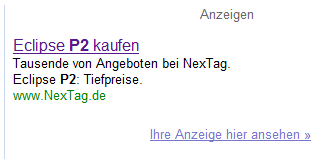
Google seems to have a funny interpretation of the search and an interesting strategy for advertisements. I was looking for a repository to get Subclipse, because the tigris.org page was down for maintenance. So I opened Google (the German version of it http://www.google.de/) to look for “Sublipse p2”. On the right side of the page, the ad has been displayed… (The translation of it from German is: Buy Eclipse p2, thousands of offers. Eclipse p2: low prices guaranteed…)
It is impressive, since I was not searching for Eclipse, but the Big Brother was able to establish the semantic link between Sublipse and Eclipse and look for Eclipse & p2. It turns out that p2 is Pentium II and Eclipse is the Fujitsu Siemens Notebook.
For all non-geeks among us: Eclipse is a the famous software platform and integrated development environment built on top of it. P2 is the system for provisioning and installation of components inside of Eclipse. Eclipse is the example for the open-source development and is available free of charge.
 Just posted an article on packaging of RCP application on TechJava. I wanted to include more enterprise systems-related stuff in it, but somehow it is more about general RCP packaging. The main difference between standard packaging and the one described is the fact that the additional feature with framework plug-ins is used. At any rate, have a look on it… By the way, the TechJava blog is now aggregated in PlanetEclipse.

I had a chance to speak about Eclipse Common Navigator Framework on Eclipse DemoCamp Hamburg – Galileo Edition. The event was a full success. Five speakers and fourty visitors were attending. After the formal part, there was an opportunity to relax at the bar of East Hotel Hamburg, thanks to Peter and Martin.
My talk was focussed on the basics of CNF. After some slides on Why, What and How, I moved on to a live coding demo and coded a small CNF view inside of an trivial RCP. Everithng worked fine, until the launch – I misspelled one id in the plugin.xml, and had to resign and showed the prepaired result instead of the hacked one. If you want to read more, check out the TechJava report.